
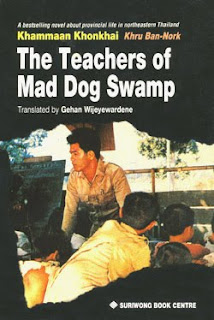
 There are pitifully few fiction books available in English that function as Thai examinations of Thai identity, but this is one of the more famous. Sompong Palasoon (under his pen name Khammaan Khonkhai) began it as a film script, filmed as Khru Ban-Nork (‘Rural Teachers’), and the book came later with its more colourful title being used for the English translation. Set in a jungle village in Thailand’s far north-east, it has to be said this isn’t a gripping read so much as an ethnographically interesting one: little happens in 300 pages apart from a minor teacher/pupil scandal, some celebrations about the building of a new classroom and the discovery and consequences of an illegal timber trade, but, as the translator Gehan Wijeyewarnede says, “the author sets out to describe the way of life of a poor village folk of a remote area of the northeastern region ... He details their speech, their economy, their technology, their festivals and their food ... He glories in the environment in which they live, the cycle of seasons, their knowledge and adaptation to it.” The characterisation is mostly well done if a little on the shallow side, and this kind of story is often more familar to Western readers when played out in an African context, and indeed the kinds of dramas described seemed rather continentally interchangeable as well. This was first published by an academic press, and is still a great book for reference if you want the minutiae of daily life in Thailand’s remote north-east. PY
AT AMAZON.CO.UK : UK PAPERBACK → ALL EDITIONS → ALL BOOKS BY KHAMMAAN KHONKHAI
12 September 2009
Khammaan Khonkhai, The Teachers of Mad Dog Swamp, 1978

10 September 2009
Lloyd Jones, Mister Pip, 2006
 This 2007 Commonwealth Writers’ Prize winner was also favourite for the 2007 Man Booker, but was ultimately beaten by Anne Enright’s The Gathering. Set in Papua New Guinea during the civil war of the early 1990s, Mr. Watts, the only white man on the small island Bougainville, becomes the only schoolteacher for a group of island children and his only realia is a copy of Dickens’s Great Expectations. The pathos starts from page one and there is some admirably sensitive handling of any number of issues that carries that pathos through to the last page, with all the accompanying horrors viewed with an impressive detachment when they arise. The viewpoint of the teenage pupil Matilda is as close to authentic as Jones could reasonably be expected to get, and the three-way tension between her, her distrusting mother and Mr. Watts is to a great extent the dynamo that drives the plot. What Matilda learns from Great Expectations, and from her own life situation, is the important stuff about survival and finding the key that gives you permission to be someone else by the transformative power of fiction. Jones’s writing is clear and uncluttered; the story, including where it unexpectedly ends up, is mostly uplifting and the result is something bittersweet, something that you warm to as well as admire. PY
MORE ON LLOYD JONES : CONTEMPORARY WRITERS PROFILE | WIKIPEDIA


