
 This short novel was begun in the early 1950s but not completed and published until 1979, and Ang Lee’s film won several trophies at Taiwan’s Golden Horse Awards. Set in occupied Shanghai during the Second World War it’s the story of a young student’s role in the entrapment of a Chinese minister who is a sympathiser of the occupying Japanese. The turbulent Chinese politics of the time always formed the backdrop to Chang’s novels and was never usually the story itself, so the political theme makes Lust, Caution an unusual story for her. It’s a convincingly told tale, and one in which the motives of all the characters are morally dubious. Chang was one of the most popular writers in China during her life but is largely out of print now in the English-speaking world, though Penguin are releasing a few titles in their Modern Classics series which, on the strength of this, will certainly be worth reading. PY
7 December 2007
Eileen Chang, Lust, Caution, 1979

Michael Ondaatje, Coming Through Slaughter, 1976
 Set in 1900 in the Storyville red light district of New Orleans, this is a loosely fictionalised but also lucidly detailed telling of the life of Buddy Bolden, the cornetist whose music and descent into madness were both factors in the birth of jazz at the turn of the 20th century. Bolden himself remains an elusive and slippery character as if Ondaatje knows he can only give a refracted portrait, with so much detail of his life being lost to history, and more than just exploring the relationships between the characters Ondaatje is also further exploring the relationship between creativity and destruction. The prose of Coming Through Slaughter is as liberating as the music, free-spirited though often deliberately disjointed and disorientating, told in rushes of solo improvisations and phrases stripped down to rhythms of speech, with words often given the precise function of musical notes. Ondaatje has allowed the story itself to completely inform his method of storytelling, giving this novel a memorable and truly poetic heart. PY
28 November 2007
Andrey Kurkov, A Matter of Death and Life, 1996
 At just thirty, Tolya is sick of life in Kiev and his failed marriage and sets himself up to be the next job for an acquaintance of an acquaintance: a hitman. But what can he do when, before the appointed hour on his last day, small opportunities come his way and he changes his mind, choosing to carry on instead? Kurkov sets up a bleakly comic situation but doesn’t play it for laughs, instead relying on some untidy situational complexities and possibilities to keep the reader engaged. Nevertheless it’s a realistically told and sometimes cynical domestic drama, and the sting in the tail is one you’ll never see coming. PY
27 November 2007
José Eduardo Agualusa, The Book of Chameleons, 2004
 In the Angolan capital Luanda, Félix Ventura is a man who creates your past – if you don’t like yours, he can come up with a new one. The book’s narrator is a gecko, also with a past life as a human, but who necessarily adopts a lizard-on-the-wall style of narration. The storytelling allows you to see the small ensemble of shifty characters from just about every angle, in a way that suggests the transience of identities and the influence of memories, real or created: everyone in this book changes who they are to various degrees. The Latin American influence on The Book of Chameleons is self-evident given that it was written in Portuguese, but ah, if only more African writing was as imaginative as this. Excellent. PY
• The Book of Chameleons is the first Angolan novel to be translated into English, and also won the 2007 Independent Foreign Fiction Prize.
Warwick Collins, Gents, 1997
 Warwick Collins is one of those cross-genre writers who defies categorisation, something that has given him a great reputation for diversity across Europe while remaining almost unheard of here, his previous UK publishers finding him impossible to ‘market’. Ezekiel, Jason and Reynolds are three West Indian attendants at a London lavatory with a problematic reputation for cottaging and casual sex, and the council requires them to do something about it. They each have their own approach to dealing with the matter, each of them moral in their own way, whether combative or pragmatic. You need to put aside any preconceptions about a book such as this: there is some superb dialogue as the focus is on the interaction between the three men as seen through the eyes of Ezekiel. Gents started as a screenplay and ended up as a novel, but would still look great filmed for TV. Very literate and acutely observed, and deservedly seen as something of a underground classic. PY
Junot Díaz, Drown, 1997
 With the release of his first novel The Brief Wondrous Life of Oscar Wao there’s a buzz about Junot Díaz, and Drown is an impressive themed collection of shorts on growing up in the Dominican Republic followed by life as a New York immigrant, and the high expectations I had of this collection were largely met; most of the stories are narrated by Yunior and focus on individuals in his family at the expense of himself, and I suspect there’s a heavy autobiographical thread running through them. The writing is for the most part crystal clear and sophisticated, observant and considerably streetwise; to Díaz language is everything and he consciously uses it to illuminate character and impart detail and a sense of place with brilliant effect. Highly recommended. PY
23 October 2007
Nada Awar Jarrar, Somewhere, Home, 2003
 The rarely mentioned centrepiece to Somewhere, Home is the long and bloody civil war that tore Beirut apart from 1975 to 1990, because this novel lies outside the peripheries of the violence and looks at the displacement and continuity of the lives of several ordinary Lebanese women and their families as they are forced to relocate away from Beirut. This was a time when there were probably more Lebanese outside the country than in, so Nada Awar Jarrar obviously has plenty of source material for these invented histories that will probably resonate fairly accurately with the real lives of many exiled Lebanese.
The three stories here, set at different times around Beirut’s civil war, are about three individual women. The first is Maysa who, while expecting a child, relocates herself away from her husband to a large rambling house on the slopes of Mount Lebanon, before he eventually joins her. Then there is Aida who has long since left the country, choosing instead to live in the cultured capitals of Europe, and yet is haunted by the spirit of a murdered Palestinian refugee who finally draws her home after the war ends. Finally we have Salwa, elderly and bed-ridden in an Australian hospital, taken from her homeland when she was a young wife and mother, recalling her old life far from home as her descendants in the wider world move on with their lives with little connection to their ‘home’ country.
Somewhere, Home is often unashamedly sentimental and mostly family-oriented, but the stories are all sufficiently picaresque to beguile the reader into wishing to know more about the characters, context and setting than we are told. A sequel novel to these lives, whether about these particular people or others entirely, would probably also be worth reading, though the tone would probably be equally melancholy. PY
• Somewhere, Home won the Best First Book Award for Southeast Asia and the South Pacific in 2004.
21 October 2007
Javier Cercas, Soldiers of Salamis, 2001
 A most unusually constructed novel, one of those in which every detail purports to be fact – something that did not prevent Soldiers of Salamis from winning the 2004 Independent Foreign Fiction Prize. Soldiers of Salamis is centred around the story of what happened one fateful day near the end of the Spanish Civil War, a day in which fascist writer and poet Rafael Sánchez Mazas cheated death twice in one day, the first time by escaping from a firing squad, the second by a soldier who hunts him down, looks him in the eye, and then inexplicably just walks away. In researching the life of Sánchez Mazas, Cercas uncovers a man whose disproportionate influence on twentieth century Spanish history far outstretched his literary abilities or political ambition, revealing him to be little more than a persuasive protofascist and coward. But who was the unknown man on which this story hinges, the executioner who didn’t pull the trigger? And might he still be alive?
Javier Cercas embeds Sánchez Mazas’s story in between two episodes of his own life, first as he decides this is a story worth writing and later as he realises the story is incomplete without looking further into the identity of the unknown soldier. While the book moves along at a steady enough pace for the first two parts, the third part – in which Cercas believes, sixty years after the event, that he has actually tracked down the mysterious man – simply soars, and the story widens out (with the help of a memorable appearance by Roberto Bolaño) to illustrate how much of history has often turned on the actions of forgotten, but extraordinary, people. Soldiers of Salamis only avoids being historical revisionism by virtue of the fact that Sánchez Mazas’s reputation has previously relied on little more than myth and received opinion, and Cercas convinces you that even if this story probably may not be true down to the very last detail, he thoroughly deserves the artistic licence in the telling of an extraordinary history. Highly recommended. PY
• Soldiers of Salamis won the 2004 Independent Foreign Fiction Prize.
Edeet Ravel, Ten Thousand Lovers, 2003
 A book that draws you in, conceivably because of the central story of a curiously unusual relationship between a pacifist Israeli student and an Israeli army interrogator of Palestinian detainees, therefore the divide to be crossed here is not racial but one defined by tolerance for political violence. Despite its 1970s setting this is contemporary left-wing Israeli fiction, anti-occupation of the Territories, and clearly informed by Edeet Ravel’s own experiences: this could conceivably be autobiography, so naturally does the dialogue flow and the situations resonate with their surroundings. Ten Thousand Lovers is less politically defined than I expected, but none the worse for that; the political dimensions take a long time to come to the fore and are felt mostly as an undercurrent beneath the surface layers, playing a necessary second fiddle to the developing relationship of Lily and Ami. The final explanation of the book’s title and also its political resonance is a shining moment, finally defining the enigmatic character of the interrogator Ami and giving the book some subtle pacifist credentials. Altogether a good read, though necessarily sentimental in parts. PY
Jennifer Clement, A True Story Based on Lies, 2001
 This book is not as difficult to pin down as its title suggests, so simple is its structure of dual narratives and yet so beguiling and engrossing is the nature of the poetic language Clement uses. A True Story Based on Lies explores the consequences of a brief sexual relationship between Leonora, a fifteen year-old native servant in a wealthy modern household in Mexico City, and Mr. O’Conner, her master. But when a child is born from this union she is raised as an adopted daughter of the house, while Leonora is expected to abandon any hope of true motherhood and merely remain the servant to the manipulations of Mrs. O’Conner, all pointing to one, possibly inevitable and tragic, conclusion.
Leonora is an innocent victim of adult games several times over, but this is not a mysogynist piece of fiction, indeed all the women of the house maintain this deception not only for the sake of their masters’ saving face, but because the alternative is Leonora returning to poverty and her child begging on the streets. The narratives contain plenty of native Indian ‘knowledge’ and other quirky strangeness, plus the right amount of pathos that imbues the Mexican servants of the house with as much dignity as innocence. Further, it describes a situation that must be common the whole world over, not just to Latin America. Certainly one of the best – and in the story’s very clever and economical telling, most original – books I’ve read this year. PY
7 October 2007
Chingiz Aïtmatov, Jamilia, 1957
 The French poet Louis Aragon described Jamilia as the world’s most beautiful love story. Small and perfectly formed it most certainly is, a sensitively told drama played out on the steppes of Kyrgyzstan and related by the teenage friend of the spirited Jamilia, whose soldier husband is hospitalised while fighting on the front. But when another crippled, silent and shell-shocked soldier returns to their village, Jamilia finds her affections are being slowly and unexpectedly pulled in a different direction. There’s an attractive, can-do decisiveness to Jamilia, and while the narrative places her firmly at the centre of her story it’s the emotional development of the narrator that has a more interesting aspect. Recommended. PY
• Aïtmatov won the 1963 Lenin Prize.
5 September 2007
Tomás Eloy Martínez, The Tango Singer, 2004
 A New York student arrives in Buenos Aires in 2001 in search of Julio Martel, a legendary and highly elusive Tango singer. But while seeking out Martel his real discoveries are of Buenos Aires’s many tragic histories, all somehow intertwined with the random performances of Martel himself, and still behind almost everything there is the ghost of Borges to deal with and the indelible stamp he made on the Porteños psyche. As a story of obsessions and a variety of very erudite madnesses, this book quickly becomes a guided tour of the city’s unwritten and mostly secret past, bringing Buenos Aires alive with an almost dreamlike lucidity. Borges still casts a very long shadow over modern Argentine literature and when the result is beautiful books like this, that is no bad thing. PY
• Martínez was shortlisted for the International Man Booker Prize in 2005.
Louise Welsh, Tamburlaine Must Die, 2004
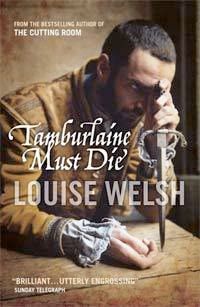 Historical novels are often helped by having damn good covers, and this is a case in point. Inside, Louise Welsh has conjured a completely engrossing fiction out of the mysterious last days of the 16th Century playwright Christopher Marlowe, as he is forced to find out who is imitating one of his most famous characters, Tamburlaine, with the intention of sending Marlowe himself to the gallows. Welsh employs a playfulness with language that reads with great conviction (even her use of the Anglo-Saxon ‘fuck’ is legitimate); nor does she go in for endless florid detail, instead getting down to a very robust kind of sketching that captures her characters with merely a few bold strokes. It reads like a fast and fleeting look through a window into the past, the dialogue is excellent, the pacing perfect and the end result memorable. PY
3 September 2007
Susan Hillmore, Malaria, 2000

MORE ON SUSAN HILLMORE : WIKIPEDIA
2 September 2007
Fred Uhlman, Reunion, 1971

MORE ON FRED UHLMAN : WIKIPEDIA


