In August 2011 Tony Parsons became writer-in-residence at Heathrow’s Terminal 5, and these seven interlinked short stories are the result of that fruitful week. Having been connected with Heathrow for most of my professional life I thought this collection might be a bit of an unrewarding ‘busman’s holiday’, but it’s the details of the working lives of other Heathrow mavens that really caught my eye, and for readers unconnected with Heathrow other than when just passing through these stories will probably be even more eye-opening: the mysterious green plane near the perimeter, the bird-scarers, the relentless attempts of small-time criminals to evade border control, the stressful lives of travelling animals, the remote coolness of the air traffic controllers, the pull of the sky and the amazement that can come from thinking too much about modern aviation. I had a problem with the feasability of the first story in this small collection but in truth that’s a minor cavil; Parsons’s characterisation is good (particularly the seen-it-all humanity of his Border Agency immigration officer Jaswinder Smith) and this successful collection is going on my shelf for keeps. Nice one, Tony. PY
MORE ON TONY PARSONS : WIKIPEDIA
15 June 2012
Tony Parsons, Departures, 2011

31 August 2010
John Wyndham, Chocky, 1968

MORE ON JOHN WYNDHAM : JOHN WYNDHAM ARCHIVE | WIKIPEDIA
6 July 2009
Graham Greene, Brighton Rock, 1938
 Sometimes your most honest appraisal of a story can be found in the first words you say to yourself when you finish it: in this case mine were “That was, again, a fantastic book.” Greene doesn’t put a foot wrong in his story of the downfall of Pinkie, a teenage gangster on the streets of 1930s Brighton, after he commits one murder too many. Greene’s getting under the skin of Pinkie is a truly class act in characterisation, equally so his nemesis, the formidably convincing Ida Arnold, who gets to the root of things with the small help of a ouija board and plenty of female intuition. There’s something quintessentially British about it all, with everyone trapped in their own circumstantial worlds and their lives intersecting in ways that can’t help but point back to their own individual loneliness. How Greene does this I’m not so sure, and in fact to analyse that some more would take away much of the pleasure: Greene can dazzle you with his writing here, if you let him. Brighton Rock is also a very catholic novel about life, with Pinkie being a defiant exception to whatever rules life may have, his come-uppance conveyed in his refusal to countenance that ‘there’s always room between the stirrup and the ground’, even when time is at its most short. A benchmark of a novel in British literature, and one that can still make a particularly hard-hitting impression. PY
MORE ON GRAHAM GREENE : WIKIPEDIA
5 July 2009
Derek Raymond, A State of Denmark, 1964
 A pull-quote on the back cover of the most recent edition describes this as “alternative science fiction on the scale of Orwell’s Nineteen Eighty-Four”, which is, frankly, rubbish: this doesn’t have the same imaginative scope, even remotely, though it is certainly a descendant of that more famous dystopia. A British socialist Prime Minister of the 1960s called Jobling reveals his true colours and quickly turns England into a relentless dictatorship, while Wales and Scotland secede from the United Kingdom and the Left just rolls over and dies. Set against Jobling is Richard Watt, a political journalist living under self-imposed exiled in Italy; this exotic and rather languorous setting for the first half of the book sets a pace that creaks along, but it’s there mostly to draw parallels with Mussolini. The second half is more descriptive of England under dictatorship and starts off far more boisterous, though endures to a downbeat finale of unceasing hopelessness. Serpent’s Tail reissued this pulp novel posthumously in 2007; it’s different from the usual English noir Robin Cook (as Derek Raymond) offered up but in places it’s plausible – a small warning that, actually, it could happen here if we let our guard down. Cautiously recommended, because in truth I suspect any aspiring British dictator would encounter far more resistance than is portrayed here. PY
MORE ON DEREK RAYMOND : WIKIPEDIA
Anthony Burgess, A Clockwork Orange, 1962
 The small but important differences between the original book and Stanley Kubrick's brutal film are not often commented on. This is still, thankfully, not yet a book to be noted for being a prediction, instead as a warning it seems to have functioned very well largely as a result of Kubrick’s truncated adaptation. But what was lost to Kubrick – he was unaware of the book’s final chapter because it was omitted from US editions – is a final sense of personal sympathy for the violent and unreliable teenage narrator, Alex. It’s actually what keeps the book alive and relevant because Burgess came down clearly on the side of his distinctly amoral anti-hero, despite having been driven to write A Clockwork Orange out of personal experience and loss from precisely the kind of violence he describes. It must have been difficult to write for that reason alone, though when set against the even greater amorality of a misguided government trying to deal effectively with youth crime it’s clear the book emerged out of Burgess asking himself some hard questions while still feeling a justifiable rage. Which makes the book a moral one, and far easier to experience than the film despite the complexities of Burgess’s invented language, Nadsat, which somehow also serves to veil the violence. Of which there’s plenty. PY
MORE ON ANTHONY BURGESS : THE INTERNATIONAL ANTHONY BURGESS FOUNDATION | WIKIPEDIA
4 July 2009
Ian McEwan, The Cement Garden, 1978
 Over a hot English summer, a family of four recently orphaned children avoid being taken into care by not telling anyone of their bereavement, instead choosing to fend for themselves. Narrated by the morose teenager Jack, The Cement Garden is soaked in an authentic atmosphere of a boring 1970s British adolescence, but their unguided excursions into premature adulthood would probably be treated as farcical and troubling comedy if they were from a less finely-tuned author. The setting seems as familiar and mundane as McEwan could possibly make it (notwithstanding the sibling sexual tension and the problem of how they dispose of certain incriminating evidence), and for a first novel it’s as dry as dust in its cold and disturbing perfection. PY
MORE ON IAN McEWAN : AUTHOR'S WEBSITE | WIKIPEDIA
Timothy O’Grady, Steve Pyke, I Could Read the Sky, 1997
 This book has been celebrated as something of a small Irish cultural event in and of itself, looking at the lives of Irish manual labourers in England. It takes the form of a old man looking back at his life, his family and the people he knew while going through decades of low-paid work in a country he feels alienated from. Noticeably absent are any adventures he may have had, instead focussing on the more mundane imagery of the unskilled jobs he’s done, his friends and the all-pervasive music they all play: those same hands that dig graves and tunnels and build roads also play flutes and accordions, something that is one of the defining points of the book. The photography of Steve Pyke is as important as the words, such is Pyke’s ability to perfectly capture Irishness when set in this context. The right music for this book is of course the album of the same name by Iarla Ó’Lionáird, which was also the soundtrack to the film. A superb and memorably haunting work. PY
• I Could Read the Sky won the 1998 Encore Award.
MORE ON TIMOTHY O’GRADY : CELTIC CAFÉ BIOGRAPHY
22 January 2008
George Orwell, Nineteen Eighty-Four, 1949
 It’s getting harder to believe there was once a time when Nineteen Eighty-Four was just a useful piece of socialist political science fiction, a somewhat far-fetched thought experiment though clearly a proverbial canary in the coal mine to the British political intelligentsia. Instead the intervening years have seen us brought considerably closer to too many aspects of Eric Blair’s vision, particularly with respect to surveillance in the UK and the conduct of political hypocrisies on a global scale. As a warning Nineteen Eighty-Four continues to serve the Western world very well indeed, and one wishes Russian and Chinese literature could have come up with equally potent fables of their own that would have had a similarly enlightening effect on their own populations and a restraining effect on their leaders: the intervening sixty years since it was written have often resonated with sentences and passages from this book that could be read as historical fact in parts of the world – the excesses of Russian and Chinese communism particularly, the former which Orwell feared English Socialism had a real danger of resembling – or echoes of the world’s present nervous condition, in which realities are habitually fabricated for entire populations in a way that would horrify our ancestors. Necessarily (and thankfully) extreme, it has inevitably become one of the defining books of the twentieth century, and with the invention of Newspeak has also made a useful and indelible stamp on the English language and conceptual thought everywhere. Doubleplusgood. PY
13 January 2008
Michael Chabon, The Final Solution, 2005
 In 1944 a silent German boy arrives in Sussex as a refugee, with a talkative African Grey parrot on his shoulder. The parrot goes missing, a murder ensues and a veteran detective comes out of retirement. The influence of Arthur Conan Doyle’s ‘Sherlock Holmes’ stories is clearly there above and beyond the usual trappings of mystery fiction, and the story also functions as a self-contained microcosm the same way that Agatha Christie’s ‘Miss Marple’ stories do, in that by knowing the ways of her village she knows the ways of the world; similarly, over the years the detective has developed an almost extrasensory intuition about people’s unseen behavioural patterns, and also seems to know what is in the air by the temperament of the bees he keeps. Michael Chabon, who won the Pulitzer Prize in 2001, writes with an extraordinary confidence in his own words that could almost convince you he’d spent time back in that era, and he quickly gets to the weary soul of the elderly detective, necessary for the reader to see how the detective himself gets to the heart of the matter. Impressive. PY
30 December 2007
Shena MacKay, Music Upstairs, 1965
 Shena MacKay’s first novel, which is set in London’s Earls Court before the ’60s had really got into their swing. Sidonie O’Neill, young, impressionable and far too passive, becomes the lover of both Pam and Lenny, her neighbours, and finds herself veering between the two while ignorant of Lenny’s increasingly obsessive behaviour towards her. Written when she was just 19, MacKay’s writing could perhaps have done with some tightening as well as some development of the scant few descriptive passages. But the narrative technique is similar to that of reality TV today, following Sidonie around while documenting the details of London life and building towards a random and unpredictable ending (while the sex remains strictly off the page). Its connection with the present is becoming ever more tenuous because it was intended to be contemporary and written very much for bohemian Londoners of the time, although the reader can still get a good sense of atmosphere and location; if memories can fill in the missing details of a grubby London bedsit life then Music Upstairs can still feel like a rather authentic journey back in time. PY
25 December 2007
Kazuo Ishiguro, Never Let Me Go, 2005
 Perhaps a book best approached with as little foreknowledge of its theme as possible, Never Let Me Go’s narrator, Kathy, at first brings you deep into her everyday life as a modern day schoolgirl, though it’s only after a couple of chapters that you begin to notice the absence of... certain essentials. The subtle hint of unease that pervades the book is captured well in one early scene, and from there the reader’s perception is given small seismic shifts by the revelations held in small incidents. Kathy’s ordinaryness contrasts with the extraordinarily cruelty of her existence; she and her friends Ruth and Tommy twine around each other and interconnect like strands of a triple helix, always looking back because they have no future, a situation that a more traditional science fictional rendition would probably have had them rebelling against. This is a linear book that rarely reveals the turns up ahead, and is all the more observant and unusual in its restraint because of Ishiguro’s controlled avoidance of dramatic distractions. Excellent. PY
• Never Let Me Go was shortlisted for the 2006 Arthur C. Clarke Award, and received a 2006 Alex Award.
27 November 2007
Warwick Collins, Gents, 1997
 Warwick Collins is one of those cross-genre writers who defies categorisation, something that has given him a great reputation for diversity across Europe while remaining almost unheard of here, his previous UK publishers finding him impossible to ‘market’. Ezekiel, Jason and Reynolds are three West Indian attendants at a London lavatory with a problematic reputation for cottaging and casual sex, and the council requires them to do something about it. They each have their own approach to dealing with the matter, each of them moral in their own way, whether combative or pragmatic. You need to put aside any preconceptions about a book such as this: there is some superb dialogue as the focus is on the interaction between the three men as seen through the eyes of Ezekiel. Gents started as a screenplay and ended up as a novel, but would still look great filmed for TV. Very literate and acutely observed, and deservedly seen as something of a underground classic. PY
5 September 2007
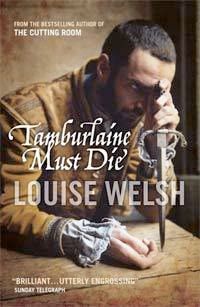
Louise Welsh, Tamburlaine Must Die, 2004