
 A worthwhile collection of stories that explores that heavily populated border between Catholicism and atheism. There is something precarious about all the characters in these three novelettes, raised on religion yet finding themselves in long-term situations where religious faith does not help: in ‘Hell Does Not Exist’, easily the best story, an abused wife attempts to protect her young son from his violent father, and yet as a teenager the son becomes the cause of personal devastation. In ‘Answer Me’ an orphaned girl with a troubled past searches for signs that she is loved while cultivating an inner hardness that allows her to carry on, and in ‘The Burning Forest’ a widower gives an account of the unravelling of his marriage while seeking the forgiveness of his estranged daughter. I was rather taken with these stories, or rather the Stygian voice with which Tamaro relates them. They were certainly not comfortable reads – I expect for people with faith they would be even less so – and their quiet power is both startling and a little disturbing. This is fiction that doesn’t shout its atheism, just quietly points out how Christianity can indeed be either an unhelpful distraction when dealing with some life’s major problems, or even the cause of them. A dark book, and necessarily so. PY
MORE ON SUSANNA TAMARO : AUTHOR'S WEBSITE | WIKIPEDIA
17 June 2012
Susanna Tamaro, Answer Me, 2001

15 June 2012
Tony Parsons, Departures, 2011
 In August 2011 Tony Parsons became writer-in-residence at Heathrow’s Terminal 5, and these seven interlinked short stories are the result of that fruitful week. Having been connected with Heathrow for most of my professional life I thought this collection might be a bit of an unrewarding ‘busman’s holiday’, but it’s the details of the working lives of other Heathrow mavens that really caught my eye, and for readers unconnected with Heathrow other than when just passing through these stories will probably be even more eye-opening: the mysterious green plane near the perimeter, the bird-scarers, the relentless attempts of small-time criminals to evade border control, the stressful lives of travelling animals, the remote coolness of the air traffic controllers, the pull of the sky and the amazement that can come from thinking too much about modern aviation. I had a problem with the feasability of the first story in this small collection but in truth that’s a minor cavil; Parsons’s characterisation is good (particularly the seen-it-all humanity of his Border Agency immigration officer Jaswinder Smith) and this successful collection is going on my shelf for keeps. Nice one, Tony. PY
MORE ON TONY PARSONS : WIKIPEDIA
4 June 2012
Roberto Bolaño, Last Evenings on Earth, 2008
 This is a combined edition of two previously released Spanish collections. These insightful stories are all anecdotal and semi-autobiographical but also mostly told in the third person, which inevitably engenders a small aura of mystery about Bolaño himself in the mind of the reader. Bolaño’s subject matter is, as usual, mostly literary: obscure South American poets, Chilean political exiles, Mexican or Spanish settings, reminiscences of lost friends, and left wing writers who like the narrator himself are all living at the far margins of the arts. Bolaño also speaks with consistency: he always writes as if relating the story by voice rather than written words and his story structure is such that you never know quite where he will end up, but wherever it is it’s usually on the cusp of what would be another story, and the endings are often abrupt. It’s impossible to pin down a favourite; they somehow blur together but are all equally very well told. A completely enchanting collection. PY
MORE ON ROBERTO BOLAÑO : WIKIPEDIA
3 June 2012
Tew Bunnag, Fragile Days, 2001
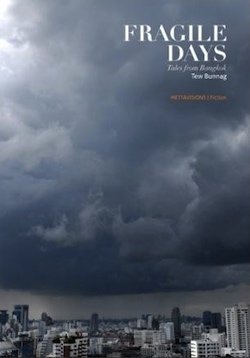 Nine stories that work well together as a cross-section of lives lived in Bangkok, from the poorest to the richest. These are less tales of status and stasis than stories of the different social strata intermixing and encountering each other, such as in ‘The Flower Girl’ in which a street orphan is adopted by a rich widow, or ‘Jeed Finds Her Brother’ in which a country girl finds out the truth about her missing brother’s life in Bangkok. These encounters inevitably leave the characters changed, yet somehow everyone at some point is a victim of the city itself, the Big Mango, for the better as often as for the worse. It’s hard to pick any story that stands out above the rest, although for characterisation the final story ‘Love Heals Tammy’ is the one that puts across best how Thais are prepared to look to the positive and be transformed by it. Bunnag also caps off the stories with a non-fiction epilogue titled ‘An Ode to the City’ in which he spells out his feelings on the ugliness of Bangkok itself, while declaring an undying admiration for the people who would dare to live in such a place. This is a lovely collection. PY
MORE ON TEW BUNNAG : INTERVIEW WITH BK MAGAZINE
31 May 2012
Tew Bunnag, After the Wave, 2005
 Tew Bunnag is a relatively new author on the Thai scene, and this collection of six stories are all centred around the 2004 tsunami which devastated Thailand’s west coast. As mostly stories of ordinary people whose lives are disrupted by that extraordinary event, this being Thailand it’s perhaps inevitable that ghosts also make an appearance as a thread that Bunnag uses to subtly link several of the stories: this was the side to his writing that I found the most enjoyable – how the tsunami somehow also became intertwined with the lives of Thailand’s ghosts; also his frequent references to the sea-gypsies known as the Moken whom Bunnag clearly knows quite well. A good collection that’s impossible to find in bookstores outside Thailand but is available from the small press Mettavisions. PY
MORE ON TEW BUNNAG : INTERVIEW WITH BK MAGAZINE
30 May 2012
Kurt Vonnegut, Look at the Birdie, 2009

MORE ON KURT VONNEGUT : AUTHOR'S WEBSITE | WIKIPEDIA
15 May 2012
Gao Xingjian, Buying a Fishing Rod for My Grandfather, 2004
 Six short tales from the 2000 Nobel Prize winner, these are succinct, ordinary stories that focus on small events, even moments, in people’s lives. Nevertheless I didn’t get as much out of this collection as I’d hoped, possibly because Gao’s habitual, philosophical navel-gazing that imbues much of his other translated work is largely absent here, and the results instead feel shackled by a self-imposed restraint – these stories are far more traditionally Chinese, with less emphasis on plot and more focus on emotive and experiential imagery. Nevertheless, these are the stories, all written between 1983 and 1990, that Gao believes best represent what he is now striving to achieve in his fiction, though one can’t help feeling what a loss it is that he had to destroy so much of his creative work in his more energetic youth under the Cultural Revolution. PY
MORE ON GAO XINGJIAN : ARTSY.NET | NOBEL PRIZE BIOGRAPHY | WIKIPEDIA
28 July 2011
Sebastian Faulks, Pistache, 2006

MORE ON SEBASTIAN FAULKS : AUTHOR'S WEBSITE | WIKIPEDIA
21 July 2011
Haruki Murakami, after the quake, 2000

MORE ON HARUKI MURAKAMI : AUTHOR'S WEBSITE | WIKIPEDIA
19 July 2011
Collin Piprell, Bangkok Knights, 1989

The first-person narrator of all the stories remains largely invisible throughout except for a couple of episodes, one which describes a journalistic trip up the Maekok river that goes disastrously wrong (in fact the only non-bar story in the collection and probably the best), and the final outing which is an interesting mixture of relationship and identity crises running in parallel, something that probably comes upon any emotionally unattached, long-time expat resident of Thailand. Piprell has also written three novels – I expect I’ll be reading them all. PY
MORE ON COLLIN PIPRELL : AUTHOR'S WEBSITE
14 June 2011
Blake Butler, Scorch Atlas, 2009

MORE ON BLAKE BUTLER : AUTHOR'S WEBLOG | WIKIPEDIA
14 May 2011
Georges-Olivier Châteaureynaud, A Life on Paper, 2010

• Edward Gauvin’s translation of A Life on Paper won the Long Form Category of the first Science Fiction and Fantasy Translation Award in 2011.
MORE ON GEORGES-OLIVIER CHÂTEAUREYNAUD : FRENCH WIKIPÉDIA
29 November 2010
Woody Allen, Mere Anarchy, 2007

MORE ON WOODY ALLEN : AUTHOR'S WEBSITE | WIKIPEDIA
2 November 2009
Kressmann Taylor, Address Unknown, 1938
 A very brief and neat exposure of the realities of Nazism, written by an acutely aware observer in the distant US before the Second World War had even begun. Two German-American friends and art dealers, one a Jew, conduct some friendly correspondence after the other returns to Munich in 1933, where he then falls under the enchanting spell of Adolf Hitler. A small but tragic event follows in Munich which, suffice to say, ensures a brilliant response. There's not much else that can be said about Address Unknown without giving the game away. America was largely uninterested in what was going on in Germany at this time but over in Europe word spread about this short serialised work, ensuring it was copied and translated (Steinbeck’s excellent The Moon Is Down, written as anti-Nazi propaganda four years later, underwent a similar propagation), inevitably ending up on Germany’s list of banned books. The simplicity and potency of Taylor’s idea ensured her a large and immediate readership, then after the war was over it was largely forgotten until its reissue in 1995 to commemorate the fiftieth anniversary of the liberation of the concentration camps. Another interesting aspect is the vehement rejection of liberalism which broadly echoes some of the same criticism you hear from the American far right today. Certainly one of the better 30-minute reads I have had this year. PY
MORE ON KRESSMANN TAYLOR : WIKIPEDIA
7 September 2009
Yasunari Kawabata, Palm-of-the-Hand Stories, 1988
 — In these brief and intense tales, all aimed at some heightened perception or ineffable truth and many based on dreams expressed or implied, we find loneliness, love, the passage of time, and death. Palm-of-the-Hand Stories captures the astonishing variety and complexity of form, setting, character, voice, and tone of one of the twentieth century’s greatest literary talents.
Seventy miniature short stories that Kawabata wrote between 1923 and 1972. It’s said the essence of Kawabata’s writing can be found in these brief episodes in Japanese lives more so than in his novels, but in truth they often feel like fragments of larger stories that Kawabata may have discarded then stripped down to their absolute minimum. Many end with a character staring into the distance, perhaps wondering something, or with an unresolved issue still hanging uncomfortably in the reader’s mind, but there’s also a sense of give-and-take here because while Kawabata often goes for the minimalist effect he’s also careful not to remove the points and markers that can give his characters an often luminous form. It’s interesting to read short stories composed differently from the way we are used to experiencing them, though the reader may still be left with a small sense of dissatisfaction with many, although those written nearer the end of Kawabata’s career are rounded off with more depth: best of all is the brief, impressive ghost story ‘Immortality’, the imaginative flourish of ‘Snow’, and ‘Gleanings from Snow Country’, loosely connected to his famous novel Snow Country. Altogether gentle and enjoyable, but frequently too slight. PY
MORE ON YASUNARI KAWABATA : NOBEL PRIZE BIOGRAPHY | WIKIPEDIA
4 July 2009
Banana Yoshimoto, Hardboiled / Hard Luck, 1999
 Two novellas that explore how two slightly unconventional Japanese women react to situations after people close to them have died, the first discovering how her awareness of the spiritual world has opened up, the second discovering how the circumstances of her late sister’s life has now given her own a new direction. Yoshimoto focuses on seemingly irrevelant details that at first make the stories feel too mundane until their importance to the development of the story is revealed. The first tale is quietly unsettling, the second an understated gem of quiet observation. PY
MORE ON BANANA YOSHIMOTO : AUTHOR'S WEBSITE | WIKIPEDIA
Bruno Schulz, The Street of Crocodiles, 1934
 Schulz was said to be the most promising Polish Jewish writer between the two World Wars until he was shot dead for no apparent reason in 1942 by a German soldier on the streets of his home town Drogobych, and this collection contains all that survives of his work. These are very private stories that superficially radiate Kafka, and Schulz goes far into the private world of his family and the central figure of his lonely, mad father whose erratic and strange behaviour is an inevitable preoccupation. This is also what drive Schulz’s stories into more imaginative territory as he watches him repeatedly break the bonds of normality and escape into other, freer states of mental being (though rarely successfully), and the failures of his father in turn seems to drive Schulz back towards the kind of idyllic summer innocence found in the first story, ‘August’. It's sometimes as if the world is all too much for him, a sentiment that drives Schulz’s artistic purpose of ‘maturing into childhood’. Fantastic elements are also here aplenty in the stories ‘Cockroaches’, ‘The Comet’ and ‘Cinnamon Shops’, a few lines of which were a pivotal source of inspiration for China Miéville’s The City & The City. Encountering Schulz’s private world can be more difficult than you might expect, but it does provide some highly entertaining and angst-ridden food for thought if you let it get under your skin. PY
MORE ON BRUNO SCHULZ : THE ART OF BRUNO SCHULZ | SCHULZIAN | WIKIPEDIA
19 June 2008
Salman Rushdie, East, West, 1994

MORE ON SALMAN RUSHDIE : AUTHOR'S WEBSITE | WIKIPEDIA
2 March 2008
Helon Habila, Waiting for an Angel, 2005
 The first story in this linked collection won the 2001 Caine Prize for African writing: a short tale about Lomba, a Nigerian journalist and political prisoner who finds himself writing love poetry, Cyrano-like, to the inept Prison Superintendent’s girlfriend. Habila went back to this character to flesh out a history and chart how he went from a girl-obsessed, soul music-loving arts correspondent to having his eyes opened by the brutality of the Abacha regime of the 1990s. A grim and depressing realism provides the detailed background which, without its roll-call of impressively idiosyncratic characters, would otherwise make this a hard book to like. PY
MORE ON HELON HABILA : AUTHOR'S WEBSITE | WIKIPEDIA
20 February 2008
Rattawut Lapcharoensap, Sightseeing, 2004
 A lively and colourful collection of stories of everyday Thai life, all set in either Bangkok or the beaches of Thailand, where the demands of Western tourism define the lives of some of the disenfranchised locals. Lapcharoensap, an Americanised Thai, writes in such a refreshing and uncomplicated way that even the worst fates to befall his colourful characters are somehow given a redeeming twist, portraying his people as unremittingly optimistic in the face of considerable personal adversity. One down side is that several stories are left open-ended and feel like the opening chapters of unfinished novels, nevertheless, he’s clearly a very promising writer to watch. PY


