
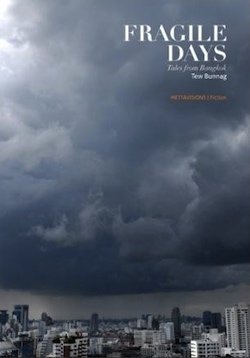
 Nine stories that work well together as a cross-section of lives lived in Bangkok, from the poorest to the richest. These are less tales of status and stasis than stories of the different social strata intermixing and encountering each other, such as in ‘The Flower Girl’ in which a street orphan is adopted by a rich widow, or ‘Jeed Finds Her Brother’ in which a country girl finds out the truth about her missing brother’s life in Bangkok. These encounters inevitably leave the characters changed, yet somehow everyone at some point is a victim of the city itself, the Big Mango, for the better as often as for the worse. It’s hard to pick any story that stands out above the rest, although for characterisation the final story ‘Love Heals Tammy’ is the one that puts across best how Thais are prepared to look to the positive and be transformed by it. Bunnag also caps off the stories with a non-fiction epilogue titled ‘An Ode to the City’ in which he spells out his feelings on the ugliness of Bangkok itself, while declaring an undying admiration for the people who would dare to live in such a place. This is a lovely collection. PY
MORE ON TEW BUNNAG : INTERVIEW WITH BK MAGAZINE
3 June 2012
Tew Bunnag, Fragile Days, 2001

31 May 2012
Tew Bunnag, After the Wave, 2005
 Tew Bunnag is a relatively new author on the Thai scene, and this collection of six stories are all centred around the 2004 tsunami which devastated Thailand’s west coast. As mostly stories of ordinary people whose lives are disrupted by that extraordinary event, this being Thailand it’s perhaps inevitable that ghosts also make an appearance as a thread that Bunnag uses to subtly link several of the stories: this was the side to his writing that I found the most enjoyable – how the tsunami somehow also became intertwined with the lives of Thailand’s ghosts; also his frequent references to the sea-gypsies known as the Moken whom Bunnag clearly knows quite well. A good collection that’s impossible to find in bookstores outside Thailand but is available from the small press Mettavisions. PY
MORE ON TEW BUNNAG : INTERVIEW WITH BK MAGAZINE
19 May 2012
Siriworn Kaewkan, The Murder Case of Tok Imam Storpa Karde, 2006

19 July 2011
Collin Piprell, Bangkok Knights, 1989

The first-person narrator of all the stories remains largely invisible throughout except for a couple of episodes, one which describes a journalistic trip up the Maekok river that goes disastrously wrong (in fact the only non-bar story in the collection and probably the best), and the final outing which is an interesting mixture of relationship and identity crises running in parallel, something that probably comes upon any emotionally unattached, long-time expat resident of Thailand. Piprell has also written three novels – I expect I’ll be reading them all. PY
MORE ON COLLIN PIPRELL : AUTHOR'S WEBSITE
23 February 2011
Chart Korbjitti, No Way Out, 1980

MORE ON CHART KORBJITTI : WIKIPEDIA
20 February 2011
Fa Poonvoralak, The Most Silent School in the World, 2009

All the above is not actually a spoiler as it would have helped to know something of the structure of the book before beginning it. It’s also rather inconclusive, but then this story was written more along ancient Eastern lines than that of a linear, modern Western text, with the analogy of the ‘Silent School’ probably meaning the life situations contained in the I Ching itself, and the physical school representing an expansion of an octagonal ba gua arrangement of Trigrams. This book is both perplexing and entertaining, and for someone who’s long been interested in both creative fiction and the inner working of the I Ching it’s also a rare and valuable find, regrettably one that I doubt will be showing up at many bookstores outside of Thailand. PY
MORE ON FA POONVORALAK : WIKIPEDIA
18 November 2010
Chart Korbjitti, Carrion Floating By, 1987

MORE ON CHART KORBJITTI : WIKIPEDIA
10 November 2010
Chart Korbjitti, Time, 1993

MORE ON CHART KORBJITTI : WIKIPEDIA
7 April 2010
Bjorn Turmann, The Last Tobacco Shop in the World, 2010

Just a few chapters into The Last Tobacco Shop in the World it becomes apparent this is an unexpected and original take on the future – one in which natural disasters are created as aphrodisiacs, in which smokers are hunted down and murdered by the state, in which interior lighting has the ability to sense human needs. My interest was sustained for over 300 pages mostly because of the tight and interesting way Turmann has with dialogue, particularly between strangers getting to know each other: they talk obliquely to produce conversations that zig-zag their way to their point. There are also some very neat future ideas in this story, set in the year 2040 on a new island called Jarangwa, a tiny slice of post-tsunami geological apocalyptica thrown up by the Andaman Sea off Thailand in 2004. Anton Brick is a freelance ‘syrup monkey’, chasing down ever-diminishing fringe supplies of oil in Iraq, then while staying in Cambodia he’s offered, and takes, a PR job at the only hotel on Jarangwa, one of the few places on Earth where it’s still entirely legal to smoke tobacco. The rest of the planet is a mess of plagues and worldwide Orwellian governmental forces that have banned love, premarital sex, small firearms (big firearms being harder to conceal) and, of course, smoking. But Anton discovers that the guests at this hotel are an unusually strange crowd including a repentant ex-spammer and a Mongolian ex-prostitute (by far the most interesting and well-drawn character), some with frightening personal ambitions and dangerously complex personalities.
Plot and setting aside, Turmann’s obvious strength is his dialogue. It’s the aspect of this novel that will probably draw the reader completely into it, with a side-effect of making one feel a little trapped inside, Prisoner-like, as one tries to figure out where this small cast of ill-matched characters is heading: occasionally as the reader I felt like the protagonist Anton, a blank slate always being kept a little in the dark and always well out of his depth. This is an enigmatic and slightly twisted novel, more slipstream than science fiction, and it’s also one of the most off-beat books I’ve read for a long time. It kept me reading less for its distinct strangeness, which is actually understated, and more for its promise, which is considerable. It has one obvious geographical error (and a rather unforgivable one as it’s relevant to the plot) which is that a boat cannot get from Cambodia’s Rabbit Island to Phuket unless it circumnavigates the entire Malay Peninsula, a journey that could not be done in a day – for convenience Turmann seems to have somehow relocated Phuket and the Andaman Sea on the other side of Thailand. That problem notwithstanding, as I write there are only 600 copies of Tobacco Shop in the world, but there ought to be plenty more as in my humble opinion this novel deserves the interest of a bigger publisher.
21 October 2009
Jane Vejjajiva, The Happiness of Kati, 2003
 Kati is a nine year-old Thai girl from Ayutthaya whose hospital-bound mother is dying of Motor Neurone Disease, and the story charts her upbringing by her grandparents and how she connects to the world immediately around her and beyond, including how she chooses to deal with the possibility of reconnecting with her estranged father. The setting is unashamedly, comfortably middle class and presents an idealistic, almost perfect environment for Kati that cushions her separation from both her parents, and this blunts the story somewhat although it’s still undoubtedly realistic. The author Vejjajiva is clearly sticking to the strata with which she’s most familiar: herself cerebral palsied and wheelchair-bound, and apart from running a Thai publishing agency and translation bureau her writing also won her Thailand’s 2006 SEAWrite Award (two years before her brother became the country’s Prime Minister). The Happiness of Kati has also been translated into six languages with a Thai film adaptation released early in 2009. This gentle story also illustrates how Thai extended families can function in more close-knit ways than they do in the West. Recommended. PY
MORE ON JANE VEJJAJIVA : WIKIPEDIA
12 September 2009
Khammaan Khonkhai, The Teachers of Mad Dog Swamp, 1978
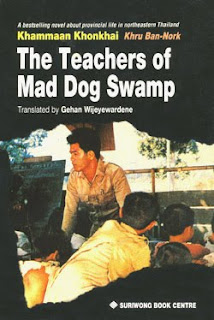 There are pitifully few fiction books available in English that function as Thai examinations of Thai identity, but this is one of the more famous. Sompong Palasoon (under his pen name Khammaan Khonkhai) began it as a film script, filmed as Khru Ban-Nork (‘Rural Teachers’), and the book came later with its more colourful title being used for the English translation. Set in a jungle village in Thailand’s far north-east, it has to be said this isn’t a gripping read so much as an ethnographically interesting one: little happens in 300 pages apart from a minor teacher/pupil scandal, some celebrations about the building of a new classroom and the discovery and consequences of an illegal timber trade, but, as the translator Gehan Wijeyewarnede says, “the author sets out to describe the way of life of a poor village folk of a remote area of the northeastern region ... He details their speech, their economy, their technology, their festivals and their food ... He glories in the environment in which they live, the cycle of seasons, their knowledge and adaptation to it.” The characterisation is mostly well done if a little on the shallow side, and this kind of story is often more familar to Western readers when played out in an African context, and indeed the kinds of dramas described seemed rather continentally interchangeable as well. This was first published by an academic press, and is still a great book for reference if you want the minutiae of daily life in Thailand’s remote north-east. PY
AT AMAZON.CO.UK : UK PAPERBACK → ALL EDITIONS → ALL BOOKS BY KHAMMAAN KHONKHAI
26 February 2008
John Burdett, Bangkok Eight, 2003
 Serious novels about modern Bangkok are always worth discovering, and this becomes a must-read given the glowing quotes (Deaver, Ellroy, Hiaasen...) that line all four sides of its front and back covers. John Burdett has gone so far under the skin of the city – and into the Thai mindset – that the rather straightforward whodunnit of a US Marine killed in a car full of snakes ends up playing a definite second string to the Buddhist prerogatives that give this book a unique direction. It is particularly well researched from the bizarre opening murder scene to the strange karmic resolution, and Burdett’s writing throughout is genuinely grown-up, multi-faceted and often darkly comic with an almost science fictional sensibility. There’s also a distinct avoidance of the more predictable clichés when dealing with Bangkok’s sex industry which forms a large part of this story’s background, giving it a level of authenticity than one might not reasonably expect from a farang author. Excellent. PY
MORE ON JOHN BURDETT : AUTHOR'S WEBSITE | WIKIPEDIA
24 February 2008
S.P. Somtow, The Other City of Angels, 2001

MORE ON SOMTOW SUCHARITKUL : AUTHOR'S WEBSITE | FACEBOOK | WIKIPEDIA
20 February 2008
Rattawut Lapcharoensap, Sightseeing, 2004
 A lively and colourful collection of stories of everyday Thai life, all set in either Bangkok or the beaches of Thailand, where the demands of Western tourism define the lives of some of the disenfranchised locals. Lapcharoensap, an Americanised Thai, writes in such a refreshing and uncomplicated way that even the worst fates to befall his colourful characters are somehow given a redeeming twist, portraying his people as unremittingly optimistic in the face of considerable personal adversity. One down side is that several stories are left open-ended and feel like the opening chapters of unfinished novels, nevertheless, he’s clearly a very promising writer to watch. PY
19 February 2008
S.P. Somtow, Dragon’s Fin Soup, 2002
 Theodore Sturgeon once called Somtow “One of the most gifted masters of colour and spectacle”, though reluctant about being labelled an ‘ethnic’ writer he long resisted writing creative fiction about Thailand. It was Fred Pohl who convinced him otherwise. Several stories in this collection of eight are notable: the truly excellent ‘The Bird Catcher’ won the World Fantasy Award for best short story, ‘Dragon’s Fin Soup’ has been optioned for a film by Japanese cult director Takashi Miike, and there is also the notably good virtual reality caper ‘The Last Time I Died in Venice’. For the most part Somtow’s preference for horror comes through as his strongest suit, and his cultural schizophrenia means he can effectively translate some distinctly Thai supernaturalities into some very well-written and crystal clear English. Recommended. PY
MORE ON SOMTOW SUCHARITKUL : AUTHOR'S WEBSITE | FACEBOOK | WIKIPEDIA
11 December 2007
Graham Joyce, Smoking Poppy, 2001
 A lonely and bitter Englishman goes to Chiang Mai in search of his daughter who is jailed on drug-smuggling charges, but is led further on a journey into the mysterious, spirit-haunted world of Thailand’s interior. Graham Joyce writes with a kind of contemporary, knowing, middle-aged English freshness; all the characters are sufficiently well-drawn to come alive vividly in the reader’s mind and the narrator never really loses his jaded cynicism throughout, though he finally succumbs to a rather belated coming-of-age as a proper parent to his two estranged twenty-something kids. An excellent book, one I would like to re-read in a few years. PY


